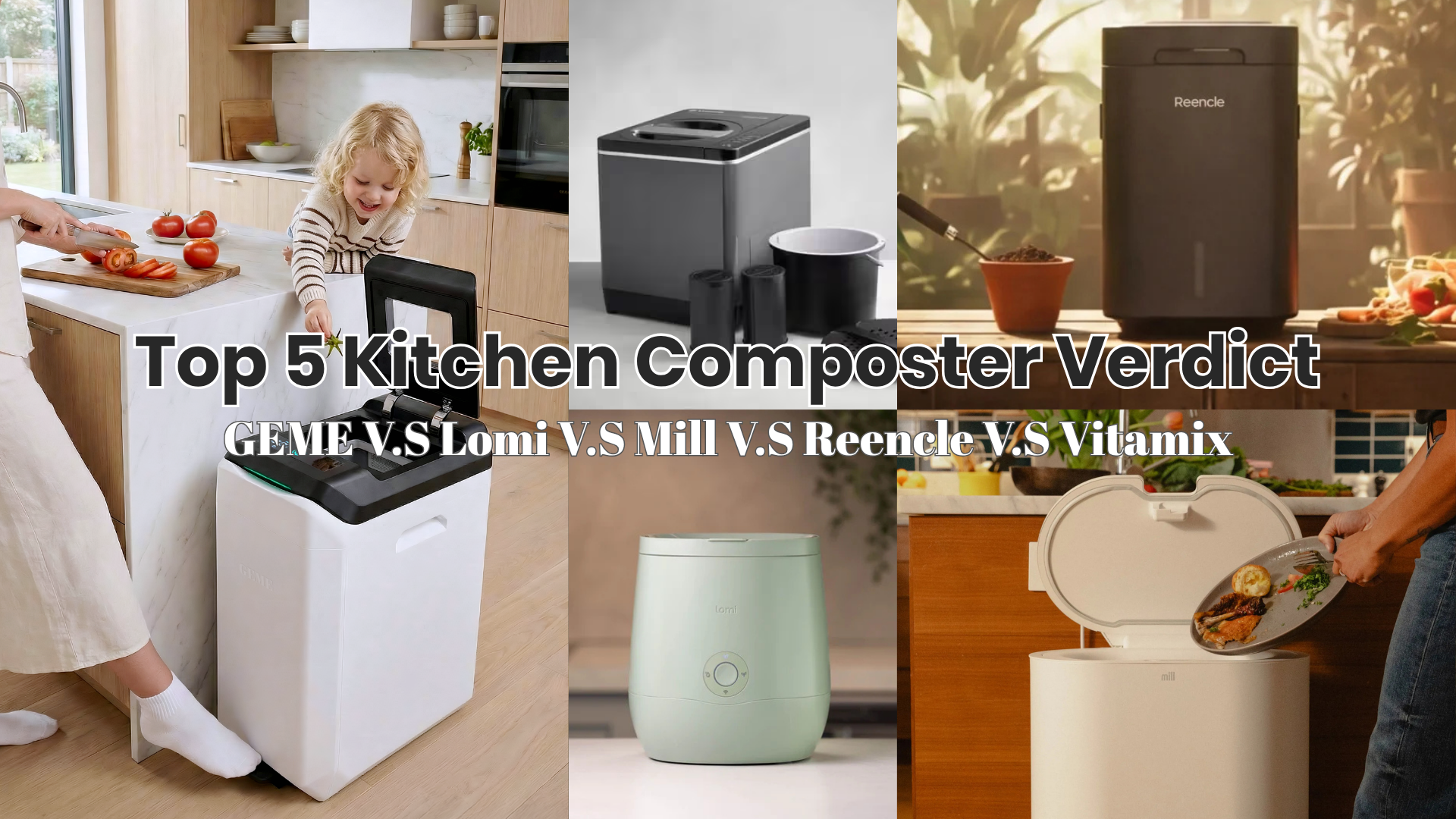
99 posts tagged with "Composting"

Composting life style

View All Tags

The “wet standard”: what living compost base should actually feel like?

· 10 min read
Moore
Moore
Tech Writer, Meteorology Journalist, Gardening Lover

TL;DR Q&A block

Should GEME output be dry and crumbly like chips?

No. The public site says the output should be moist and soil-like, not dry chips, and the manual describes it as an active compost base rather than dehydrated residue.

Does “wet” mean something went wrong?

Not by itself. The correct target is a living, microbe-active compost base. The manual only treats the chamber as too wet when it becomes muddy or sticky, and the display indicates a wet state that needs recovery.

Is the output supposed to be finished compost every time?

No. The site explicitly states that the “6–8 hour” claim refers to high-activity base forming, not finished compost, and that maturity varies with continuous feeding and curing.

What if there are larger pieces in the output?

That is normal. Official guidance says to sift out larger pieces and return them to the cycle.

How should I use the output in soil?

The public guidance is to mix it with soil, not use it as a pure planting medium. The manual recommends about 1 part GEME compost base to 8 parts soil, with adjustments based on plant sensitivity.

What Does GEME Compost Base Look Like

Why low average power matters more than dramatic peak wattage?

· 10 min read
Moore
Moore
Tech Writer, Meteorology Journalist, Gardening Lover

TL;DR Q&A block

Does GEME use a lot of electricity in daily life?

The honest answer is: it uses a dynamic load, not one fixed number. Public guidance gives Terra 2 and GEME Pro reference figures, but real use changes with feed volume, moisture, ambient temperature, and how often you add scraps.

What matters more: peak wattage or average power?

Average power matters more for real ownership because it tells you how the machine behaves most of the day, while peak wattage only tells you the upper ceiling at certain moments. GEME’s public hard-parameter sheet explicitly gives both average and peak figures for that reason.

How is GEME different from a high-heat batch machine?

The official site says Terra 2 uses minimal power to maintain temperature and only ramps when new waste is detected; it is described as “not a constant heater.” That means the system is trying to maintain a living operating window, not blast heat all day.

Why can electricity use vary from one home to another?

Because this is a living process. Power demand changes with what you add, how wet it is, how much you add at once, how often you open the lid, and how cold the room is. The Terra 2 manual also states that power consumption may increase in low temperatures to maintain microbial activity.

What is the public reference for Terra 2 and GEME Pro?

The locked external parameter sheet allows Terra 2 to be stated as Average 60W / Peak 360W / Daily avg ~1.5 kWh and GEME Pro as Average 60W / Peak 500W / Daily avg ~1.85 kWh. Terra 2 is publicly positioned at 2 kg/day, while GEME Pro is publicly positioned at 5 kg/day.

GEME Low Average Power Consumption

How to Avoid Food Poisoning Related to Leftovers: The Science Behind Leftover Food

· 17 min read
Moore
Moore
Tech Writer, Meteorology Journalist, Gardening Lover

Introduction: The Leftover That Almost Killed a College Student

In 2008, a 20-year-old Belgian college student ate leftover pasta that had been sitting at room temperature for five days. Within hours, he developed severe nausea, abdominal pain, and vomiting. Despite receiving medical care, he died the next day. The cause? A bacterium called Bacillus Cereus, in a case that became known worldwide as "Fried Rice Syndrome".

This wasn't an isolated freak accident. In 2026, a man in China suffered multiple organ failure after eating improperly stored leftover rice that was later turned into fried rice. The same month, 97 employees at an office canteen in Bengaluru fell ill after consuming contaminated food, with symptoms including vomiting, nausea, and stomach pain.

The Centers for Disease Control and Prevention (CDC) estimates that 48 million Americans get sick from foodborne illnesses every year. Of those, 128,000 are hospitalized, and 3,000 die. A significant portion of these cases are linked to leftovers, food that people assumed was safe to eat simply because it had been refrigerated.

The science of leftover food poisoning is more complex than most people realize. This article will walk you through the hidden dangers in your refrigerator, the bacteria that cause the most harm, and exactly how to protect yourself and your family.

Fried Rice Syndrome

GEME Composter vs DIY Bokashi: Which Should You Choose?

· 15 min read
Moore
Moore
Tech Writer, Meteorology Journalist, Gardening Lover

Introduction: Two Ways to Turn Trash into Treasure

You want to compost. You really do. But your apartment has no yard, your schedule has no spare hours, and your nose has no tolerance for rotting food smells.

So you start researching indoor options. Two names keep coming up: GEME Composter and Bokashi.

Here’s the problem. Most articles treat these as interchangeable solutions. They’re not. One is a high-tech appliance that lives on your kitchen floor and produces real compost in days. The other is a DIY fermentation bucket that pickles your scraps and leaves you with a half-finished product that still needs soil to finish breaking down.

I’ve spent weeks digging through user experiences, technical specs, and side-by-side comparisons to figure out which one actually delivers on its promises. Not marketing hype. Just real results.

In this guide, I’ll walk you through exactly how each method works, what they cost to own (including hidden costs nobody talks about), and which one fits your specific situation. By the end, you’ll know whether you’re a GEME person or a Bokashi person.

GEME Composter

Permanent Odor Control: Catalyst Path vs. Disposable Carbon

· 9 min read
Moore
Moore
Tech Writer, Meteorology Journalist, Gardening Lover

Q&A Block

Does GEME make odor control simpler in daily use?

Yes. GEME’s public system logic is built around continuous operation, no routine filter-replacement subscription, and no after-every-use cleaning ritual. Its deodorization method is publicly named Metal-Ion Oxidation Catalyst.

Do I need to change filters all the time?

No. GEME’s public benefit claim is that odor control does not depend on recurring replacement filters.

Do I need to clean the machine after every use?

No. Official care guidance says GEME does not require cleaning after each use; routine care is occasional and situation-based.

So is it “add and forget”?

In normal use, yes, that is the intended user experience. GEME is designed as a continuous aerobic bio-processor that runs 24/7, so users do not need to wait for a batch to finish before adding scraps.

Can odor still happen?

Yes, but usually the difference is between opening the lid and living with the machine closed. If the chamber gets temporarily too wet, you may notice a stronger smell when the lid is open. Once the lid is closed and the system returns to normal operation, GEME is designed to keep odor controlled inside the machine rather than letting it spill into the kitchen.

GEME Terra 2

GEME Composter Review 2026: Real Compost, No Filter costs

· 13 min read
Moore
Moore
Tech Writer, Meteorology Journalist, Gardening Lover

After testing the GEME World First Bio Smart 19L Electric Composter for a month, here's how it performs for my daily kitchen waste management. Spoiler: the smell is the first thing you'll notice, or rather, the lack of it.

We've all been there. You open the kitchen bin to toss in some scraps, and that wave of stale, rotting smell hits you. You hold your breath, dump the waste, and shut the lid quickly. It's not exactly a pleasant routine, but it's one we've accepted as normal. The GEME Electric Composter aims to change that.

This isn't just another kitchen gadget. It's a genuine biological processing unit that lives in your kitchen and quietly turns your food scraps into actual, usable compost. I've spent a month using this machine, digging through the science, and comparing it to the competition. Here's my honest review.

GEME Composter Product Review

Why is the GEME chassis intentionally heavier than a typical countertop appliance?

· 10 min read
Moore
Moore
Tech Writer, Meteorology Journalist, Gardening Lover

Q&A Block

Why is GEME heavier than many countertop compost gadgets?

Because it is built as a continuous aerobic bio-processor with a floor-standing chamber, turning shaft, airflow path, and structure meant to stay stable under daily biological load, not as a light batch dehydrator.

Does heavier automatically mean quieter?

No. Officially, Terra 2 is positioned for apartments and open kitchens, and the site describes a 35–40 dB operating experience, but perceived quietness still depends on floor rigidity, wall clearance, room background noise, and what you feed it.

Is Terra 2 built the same way as GEME Pro?

They share the same biological logic, but they are positioned differently: Terra 2 is the household core model at 2 kg/day, while GEME Pro is the heavy-duty model at 5 kg/day with a longer maintenance interval target.

Is this about “premium heft” or actual engineering?

Actual engineering. The relevant question is not “Is it heavy?” but “What does that mass do for stability, vibration behavior, and load headroom in a real kitchen?” That is the practical design question behind the chassis.

Should I choose based on weight alone?

No. Choose based on household size, daily capacity, installation environment, and how much load headroom you want—not on the abstract idea that lighter is always better or heavier is always better.

GEME Terra 2

How to Compost in an Apartment (Best Solution 2026)

· 6 min read
Moore
Moore
Tech Writer, Meteorology Journalist, Gardening Lover

For many people living in apartments, the idea of composting sounds great in theory — and absolutely miserable in practice. You care about sustainability. You want to reduce food waste. You’ve read about composting being the foundation of a zero-waste lifestyle. And then reality hits: smell, bugs, mess, and endless maintenance.

This article is not here to romanticize traditional composting. It’s here to explain why it fails in apartments, and more importantly, how modern apartment dwellers can finally compost at home without odor, insects, or effort.

How to Compost At Home In Apartment

What Can You Put in an Electric Composter? Meat, Dairy, Bones (Clear Rules + Hard Limits)

· 5 min read
Moore
Moore
Tech Writer, Meteorology Journalist, Gardening Lover

Evidence Header

One-sentence takeaway

Most people don’t need a fantasy list—they need a decision system: meat/dairy can be OK in normal leftovers when the process stays aerobic, but large dense bones and shells are hard limits, and “wet + greasy + dense” loads raise odor risk.

Why it matters in the kitchen

This question decides adoption. If users can’t load real leftovers, they won’t keep the habit. If they load “hard-no” items, they blame the machine. Clear rules protect both user experience and output quality.

What we tested (high-level, no secrets)

We assessed typical leftover categories (cooked meals including meat/dairy) for workflow stability and odor-risk behavior under normal loading, plus failure cases tied to density, hardness, and excess liquids.

What we didn’t test / not claiming

We are not claiming every meat/dairy scenario works equally. We are not publishing microbial composition or control thresholds.

Methods & boundaries

Methods & boundaries → Open GK Verification

Can you Put Meat and Bones In Composter?

Can an Electric Composter Handle Salt & Oil? Boundaries for Real Leftovers (Without the Myths)

· 5 min read
Moore
Moore
Tech Writer, Meteorology Journalist, Gardening Lover

Evidence Header

One-sentence takeaway

Salt and oil don’t “kill composting.” They narrow the aerobic window—so the winning strategy is simple: protect oxygen flow, manage moisture, drain free liquids, and don’t dump brine or fryer oil.

Why it matters in the kitchen

This is the #1 trust question. If a brand dodges salt/oil, it’s not honest. If a brand claims “everything works,” it’s not engineering. Clear boundaries reduce smell, reduce user error, and protect output quality.

What we tested (high-level, no secrets)

We evaluated performance across realistic leftover patterns (lightly seasoned → sauce-heavy → oily/salty) and tracked behavioral outcomes: odor risk signals, cycle stability, and whether the mass stayed aerobically active under normal household use.

What we didn’t test / not claiming

We do not claim unlimited brine/grease tolerance. We do not claim identical results across every household diet. We also don’t publish proprietary control parameters, microbial composition, or internal thresholds.

Methods & boundaries

Methods & boundaries → Open GK Verification

GEME Composting Soil and Oil Guide